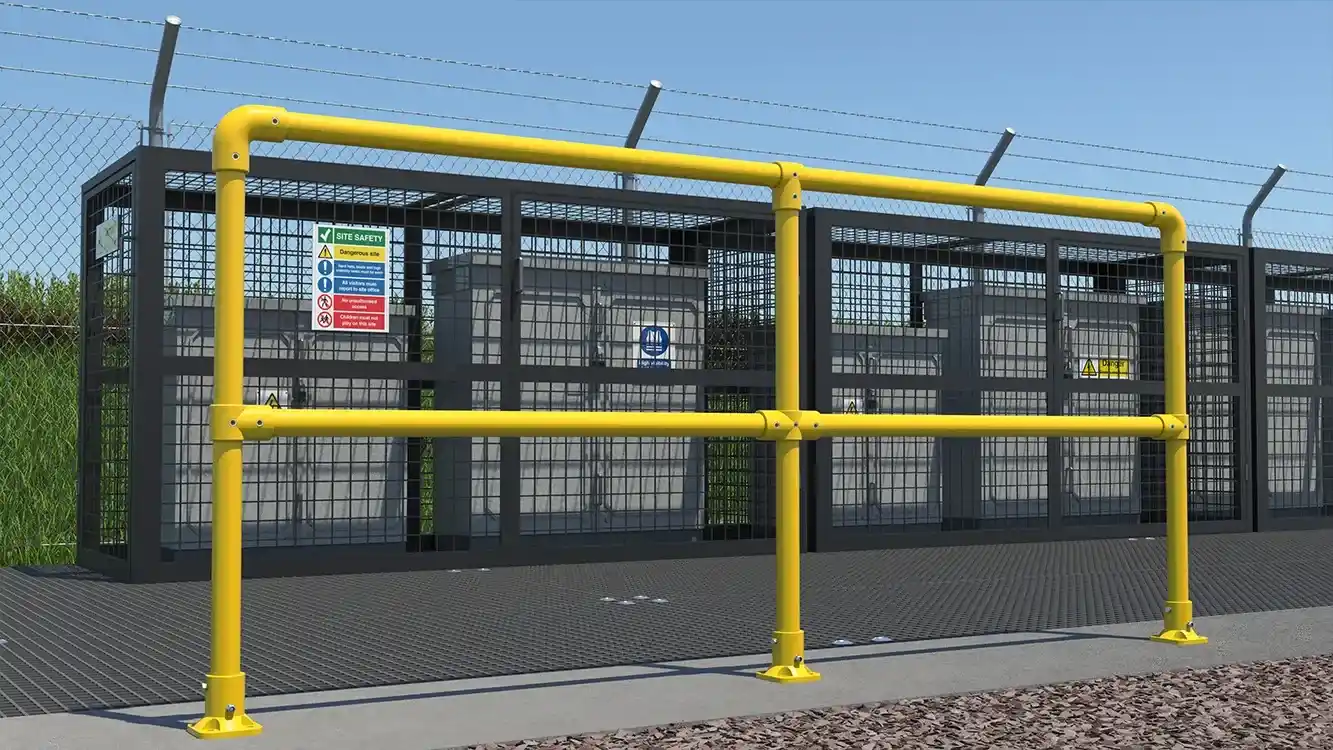
Introduction
When it comes to industrial safety infrastructure, the debate of FRP Composites vs. Steel has become increasingly important for engineers and facility managers. The question of why composites come out on top in guardrail applications is one that demands a thorough comparison of material properties, cost implications, and long-term performance. This complete comparison guide examines both materials across every relevant metric to help you make an informed decision for your next guardrail project.
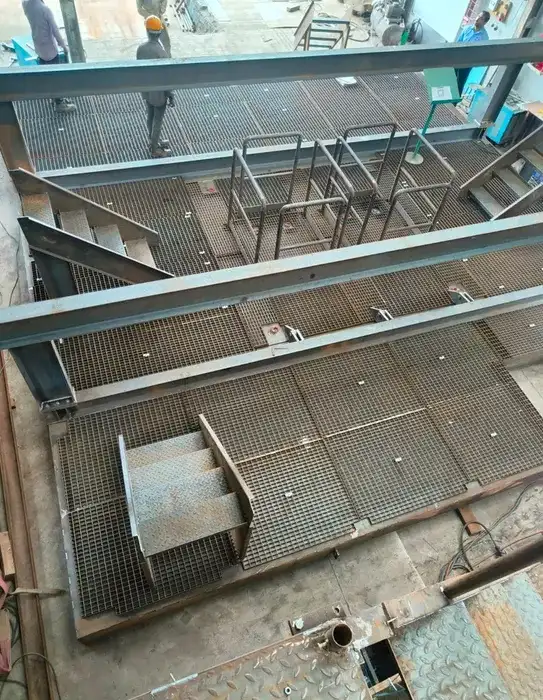
Steel has been the traditional material of choice for guardrails for decades, valued for its strength and familiarity. However, FRP composite guardrails have emerged as a compelling alternative that addresses many of steel inherent weaknesses. From chemical plants to marine environments, industries are discovering that the advantages of FRP extend far beyond simple corrosion resistance.
In this guide, we will compare FRP composites and steel guardrails across strength, corrosion resistance, lifecycle costs, installation, weight, thickness requirements, and industry adoption. By the end, you will understand why an increasing number of organizations are making the switch and how to evaluate which material suits your specific application.
What Are FRP Composites and Steel Guardrails?
Understanding FRP Composite Guardrails
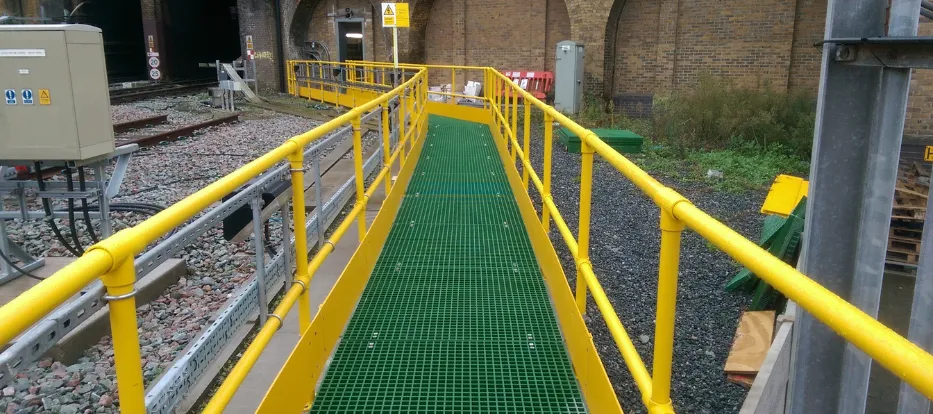
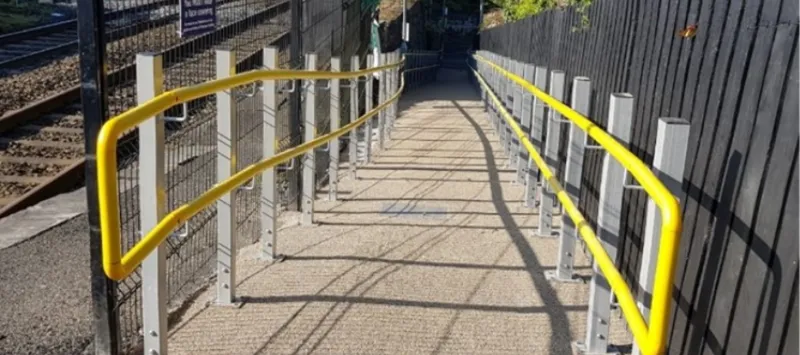
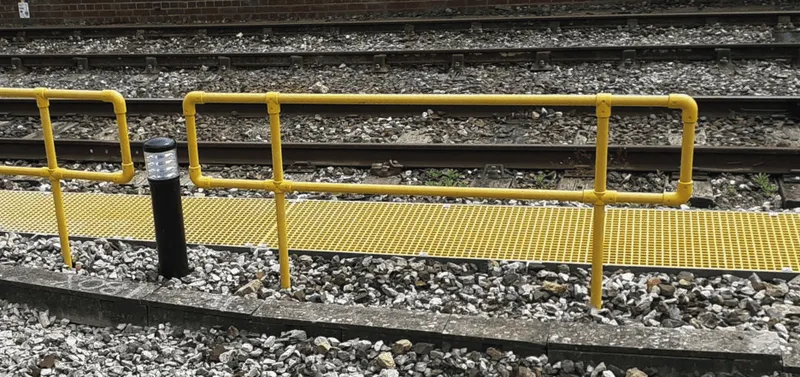
FRP (Fiberglass Reinforced Polymer) composites are advanced materials made from high-strength glass fibers embedded in a polymer resin matrix. In guardrail applications, FRP composites are manufactured through pultrusion, a continuous process that produces consistent, high-strength profiles with excellent structural properties. The result is a guardrail system that delivers impressive strength-to-weight ratios while remaining completely immune to electrochemical corrosion.
FRP composite guardrails are engineered to meet specific load requirements through careful control of fiber orientation, resin formulation, and profile geometry. Unlike steel, which derives its properties from metallurgical composition and heat treatment, FRP can be tailored during manufacturing to optimize for specific performance characteristics such as impact resistance, flexural strength, or UV stability.
Traditional Steel Guardrail Systems
Steel guardrail systems have been the industry standard for decades. Made from galvanized or carbon steel, these systems rely on the material inherent strength and ductility to absorb impact energy. Steel guardrails are typically hot-dip galvanized or coated with paint systems to protect against corrosion, though this protection degrades over time in harsh environments.
Steel guardrails come in various configurations including W-beam, thrie-beam, and cable systems. They are widely used on highways, industrial sites, parking structures, and perimeter safety applications. While steel offers well-understood performance characteristics and established design codes, its susceptibility to corrosion remains a significant limitation, particularly in chemical, marine, and wastewater treatment environments.
FRP Composites vs. Steel: Key Differences at a Glance
When comparing FRP Composites vs. Steel guardrail systems, several key differences emerge that directly impact performance, cost, and longevity. The following table summarizes the core distinctions:
| Property | FRP Composite Guardrail | Steel Guardrail |
|---|---|---|
| Corrosion Resistance | Excellent — inherently immune to rust and chemical attack | Poor without coatings — requires galvanization or paint |
| Weight | 75-80% lighter than steel | Heavy — requires mechanical lifting equipment |
| Tensile Strength | Comparable to steel per unit weight | High — well-characterized |
| Electrical Conductivity | Non-conductive | Conductive — requires grounding |
| Thermal Conductivity | Low — stays cool to touch | High — becomes hot in sunlight |
| Maintenance Requirements | Minimal — no painting or rust treatment | Regular — repainting, rust repair, coating renewal |
| Installation Labor | Lower — lighter materials, simpler handling | Higher — heavy lifting, welding, bolting |
| Service Life | 25-50+ years with minimal degradation | 10-20 years before significant corrosion in harsh environments |
| Upfront Material Cost | Higher initial investment | Lower initial cost |
| Lifecycle Cost | Lower over 20+ years | Higher due to maintenance and replacement |
These differences explain why FRP Composites vs. Steel comparisons increasingly favor FRP for guardrail applications, especially in aggressive environments where steel requires constant upkeep. The FRP vs steel comparison becomes even more compelling when you factor in installation savings and reduced downtime for maintenance.
Is FRP as Strong as Steel for Guardrail Applications?
A common question when evaluating FRP vs steel guardrail systems is whether FRP can match the strength of steel for industrial safety applications. When considering structural FRP vs. steel for guardrail applications, the answer is nuanced: FRP composites offer tensile strength comparable to steel when properly engineered, but their behavior under load differs significantly.
Steel exhibits ductile behavior — it bends and deforms plastically before failure, which provides visible warning signs. FRP composites, by contrast, are elastic up to the point of failure and do not exhibit the same yielding behavior. This does not mean FRP is weaker; rather, it requires different design approaches. When engineered correctly, FRP composite guardrails meet or exceed the impact resistance requirements of industrial safety standards including OSHA and IBC regulations.
The key strength metrics break down as follows:
- Tensile Strength: FRP composites achieve 30,000-60,000 psi depending on fiber orientation and resin system, comparable to many structural steels.
- Specific Strength (Strength-to-Weight): FRP significantly outperforms steel when strength is normalized by weight, making it ideal for lightweight structural applications.
- Impact Resistance: Modern FRP formulations include impact modifiers and specialized fiber architectures that deliver excellent energy absorption.
- Flexural Strength: FRP guardrail profiles are designed with section geometry that compensates for the lower modulus of elasticity compared to steel.
For the vast majority of industrial guardrail applications — including perimeter safety, platform edge protection, and vehicle impact barriers — properly designed FRP guardrail systems provide all the structural performance required while delivering significant advantages in corrosion resistance and weight.
Corrosion Resistance: FRP vs Steel in Harsh Environments
Corrosion is the single greatest weakness of steel guardrails and the primary reason industries are switching to FRP. The question of how FRP composites perform in corrosive environments vs steel has a clear answer: FRP is inherently corrosion-proof, while steel requires continuous protection that inevitably degrades.
Steel guardrails in corrosive environments face multiple attack mechanisms:
- Galvanic corrosion — occurs when steel contacts dissimilar metals in the presence of an electrolyte
- Chemical attack — acids, alkalis, and industrial solvents rapidly degrade protective coatings
- Saltwater corrosion — chloride ions penetrate galvanized coatings, accelerating rust in marine environments
- Atmospheric corrosion — humidity and oxygen combine to form rust on exposed surfaces
- Crevice corrosion — develops under bolted connections and overlapping surfaces
Even hot-dip galvanized steel eventually succumbs to corrosion in aggressive environments. Typical protection lasts 10-15 years in industrial settings before significant maintenance is required. In chemical plants and wastewater facilities, this timeline can be even shorter.
FRP composites, on the other hand, offer permanent corrosion resistance because the glass fibers are fully encapsulated in a chemically inert resin matrix. The resin system can be selected specifically for the chemical environment — vinyl ester resins for superior chemical resistance, isophthalic polyester for general industrial use, or flame-retardant formulations for fire-rated applications. This inherent corrosion resistance means FRP guardrails require no painting, no galvanizing, and no periodic rust remediation over their entire service life.
Lifecycle Cost Analysis: FRP vs Steel Guardrail
When comparing how the lifecycle cost of FRP compares to steel, the initial purchase price tells only part of the story. A proper lifecycle cost analysis must account for installation, maintenance, repair, replacement, and downtime costs over the full service life of the guardrail system. This is where FRP Composites vs. Steel diverges most dramatically in terms of total cost of ownership.
The initial material cost of FRP guardrails is typically 30-50% higher than galvanized steel. However, this upfront premium is offset by substantial savings in other areas:
| Cost Factor | FRP Composite Guardrail | Steel Guardrail |
|---|---|---|
| Material Cost (per linear foot) | $$$ Higher upfront | $$ Lower upfront |
| Installation Labor | $ Lighter weight reduces labor | $$$ Heavy sections require cranes and more workers |
| Equipment Requirements | $ Hand-carried, no heavy machinery | $$$ Forklifts, cranes, welding equipment |
| Annual Maintenance | $ Minimal inspection only | $$$ Painting, rust repair, coating touch-ups |
| Replacement Frequency | Once every 25-50 years | Every 10-20 years in corrosive environments |
| Downtime for Maintenance | Virtually none | Significant — production halts for repairs |
| Total 20-Year Cost | $$ Lower | $$$ 2-4x higher |
The lifecycle cost advantage of FRP becomes even more pronounced in corrosive environments. A chemical processing plant that installs steel guardrails will face recurring maintenance costs every 2-3 years for repainting and rust repair, with full replacement required within 15-20 years. The same installation using FRP composites will require nothing beyond routine inspection for a quarter-century or more.
When you factor in the cost of production downtime during guardrail maintenance — a hidden but significant expense — the lifecycle cost comparison strongly favors FRP composites. Many organizations find that the total cost of ownership for FRP is 40-60% lower than steel over a 20-year evaluation period.
Weight and Installation: FRP vs Steel Guardrail Systems
One of the most practical differences between FRP and steel guardrails is weight. FRP composites weigh approximately 75-80% less than equivalent steel sections, which creates significant advantages throughout the entire installation process.
A standard steel guardrail section weighing 200-300 pounds requires multiple workers, a forklift or crane, and careful rigging for positioning. The same section in FRP weighs 40-60 pounds and can be carried and positioned by two workers without mechanical assistance. This weight difference affects every aspect of the installation:
- Reduced labor costs: Smaller crews can complete installations faster
- No heavy equipment needed: Eliminates crane and forklift rental expenses
- Simplified foundation requirements: Lighter guardrails impose lower dead loads on support structures
- Easier retrofitting: FRP can be installed on existing structures without structural reinforcement
- Improved safety: Reduced manual handling risks for installation crews
The FRP vs steel guardrail system comparison on installation efficiency shows that FRP systems typically install 2-3 times faster than equivalent steel systems. This translates directly to lower project costs and reduced disruption to facility operations.
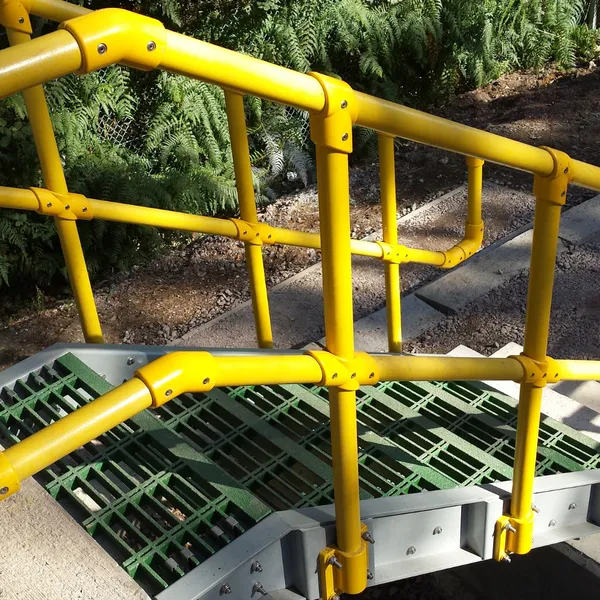
FRP guardrails also use simpler connection methods. Rather than welding or heavy bolting, FRP sections typically fasten with stainless steel bolts and purpose-designed brackets. Connections can be made with standard tools, and the non-conductive nature of FRP eliminates the need for grounding considerations that complicate steel installations near electrical equipment.
Industries Switching from Steel to FRP Composites
A growing number of industries are making the switch from steel to FRP composites for guardrail and safety infrastructure. The industries switching from steel to FRP composites share common challenges: corrosive environments, weight constraints, and high maintenance costs.
Here are the key sectors leading this transition:
- Chemical Processing Plants: The presence of acids, caustics, and industrial solvents rapidly degrades steel guardrails. FRP composites offer complete chemical resistance, eliminating recurring rust and coating failures that plague steel installations in these environments.
- Wastewater Treatment Facilities: Hydrogen sulfide gas and chlorine exposure create highly corrosive conditions. FRP is the material of choice for guardrails, handrails, and structural platforms in treatment plants nationwide.
- Marine and Offshore: Saltwater spray and constant humidity make steel corrosion a losing battle. FRP guardrails provide permanent protection without the need for painting or galvanizing, making them ideal for ports, piers, and offshore platforms.
- Food and Beverage: Frequent washdowns with harsh sanitizing chemicals accelerate steel corrosion. FRP composites withstand repeated cleaning with caustic agents while remaining food-grade safe.
- Power Generation: Both conventional and nuclear power plants use FRP guardrails in cooling towers, chemical treatment areas, and switchyards where non-conductivity is essential for worker safety.
- Mining and Mineral Processing: Abrasive dusts, chemical reagents, and high humidity create conditions that destroy steel guardrails within a few years. FRP offers extended service life with minimal maintenance.
The trend is accelerating as more industries recognize that the advantages of FRP composites over steel translate directly to operational savings and improved safety outcomes.
FRP vs Steel Guardrail Thickness and Design Considerations
When evaluating FRP vs steel guardrail thickness, it is important to understand that direct thickness comparisons are misleading because the materials have fundamentally different mechanical properties. FRP composites have a lower modulus of elasticity than steel, meaning they are less stiff. However, this is compensated through profile design rather than simply increasing thickness.
Here are the key design considerations when comparing FRP and steel guardrails:
- Profile Geometry: FRP guardrails are designed with deeper sections, wider flanges, and optimized shapes that compensate for the lower modulus while maintaining structural performance. A typical FRP guardrail beam may be 20-30% deeper than an equivalent steel section but weighs 75% less.
- Section Modulus: The structural efficiency of FRP is achieved by designing the cross-section to maximize the moment of inertia, ensuring adequate stiffness for the application without excessive material use.
- Connection Design: FRP connections are engineered to distribute loads effectively through bearing plates and bolted joints. Unlike steel, FRP should not be welded, but modern connection systems are well-proven in thousands of installations.
- Safety Factors: FRP guardrail designs typically incorporate higher safety factors due to the material anisotropic nature and lack of ductility. Most FRP guardrails are designed with safety factors of 2.5-3.0 against ultimate failure.
Design standards for FRP guardrails are well established through organizations such as ASCE, ACI, and industry-specific guides. When specifying guardrail thickness and design, engineers should rely on manufacturer load tables and certified test data rather than attempting to equate FRP thickness to steel thickness directly. The FRP vs steel comparison on thickness is ultimately about engineered performance, not simple dimensional equivalence.
Conclusion
After a thorough examination of FRP composites vs. steel for guardrail applications, it becomes clear why composites come out on top in a growing range of industrial and commercial settings. While steel remains a viable choice for clean, dry indoor environments with minimal corrosion risk, FRP composites offer decisive advantages in the applications that matter most to modern industry.
To summarize the key findings of this FRP vs steel guardrail comparison:
- Corrosion resistance is FRP clear advantage — steel requires ongoing protection that adds cost and labor
- Strength is adequate for virtually all industrial guardrail applications when properly engineered
- Lifecycle costs favor FRP by 40-60% over 20 years due to elimination of maintenance and replacement
- Weight and installation advantages reduce project costs and improve safety during construction
- Design flexibility allows FRP to be optimized for specific loads and environmental conditions
The advantages of FRP composites over steel are most pronounced in corrosive environments where steel requires constant maintenance. As more industries — from chemical processing to marine infrastructure — recognize these benefits, the trend toward FRP composites continues to accelerate. For your next guardrail project, consider the total cost of ownership, the environmental conditions, and the long-term performance requirements. In most cases, you will find that FRP composites deliver superior value over the full lifecycle of the installation.