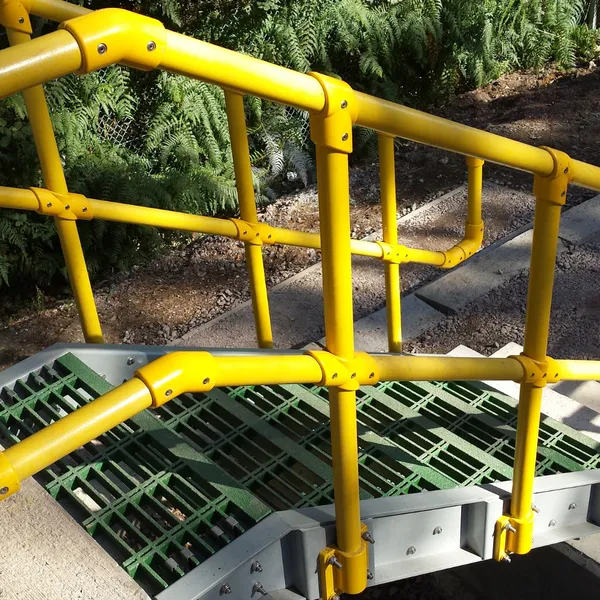
Why Choosing the Right FRP Guardrails Manufacturer Matters
Your FRP guardrail system protects workers in corrosive, high-voltage, and safety-critical environments for 25+ years. The manufacturer behind those guardrails determines whether you get precise ASTM-tested components with full traceability — or cut-rate pultrusions that fail inspection. For procurement officers and engineers sourcing industrial FRP railing, the difference between a qualified factory and a trading company can mean project delays, non-compliant materials, and costly rework.
This guide explains exactly what to look for when evaluating FRP guardrail manufacturers — from certifications and quality control to pricing, MOQ, and logistics. It also introduces Dengtai's factory-direct manufacturing capabilities so you can benchmark any supplier against a proven standard.
7 Critical Factors to Evaluate an FRP Guardrails Manufacturer
1. ISO 9001 Certification
Verify the certificate is current and covers FRP pultrusion manufacturing — not just trading or distribution. Ask to see the certificate scope.
2. ASTM Testing Data
Request actual test reports: ASTM E-84 (fire rating), ASTM D638 (tensile). A qualified manufacturer provides these — not just claims compliance.
3. Production Capacity
Ask about annual output (tons), pultrusion line count, and capacity utilization. Avoid factories running at 100% — lead times will slip.
4. Export Experience
How many countries do they ship to? Do they handle HS codes, export docs, and customs? First-time exporters create delays.
5. Quality Control Process
Look for: in-process dimensional checks, post-cure inspection, load testing, and batch-level material traceability. Ask for their QC checklist.
6. Customization Capability
Can they engineer non-standard heights, custom colors, or special fittings? In-house engineering adapts — a trading company cannot.
7. References & Track Record
Ask for project references in your industry. A manufacturer with 500+ completed projects has proven reliability across real-world conditions.
Red Flags: Signs of an Unreliable FRP Guardrail Supplier
Just as important as knowing what to look for is recognizing what to avoid. These warning signs often indicate a supplier that will cause project delays, quality issues, or compliance failures:
If the "Contact Us" page shows only a sales office or PO Box — not a verifiable manufacturing address — you are likely dealing with a trading company. Search the address on Google Maps. A pultrusion factory has visible production buildings, raw material storage, and shipping docks.
Any legitimate manufacturer welcomes buyers to inspect their facility. If a supplier makes excuses — "renovations," "confidentiality," or "our factory is too far" — walk away. A 10-minute video call showing the production floor is the minimum acceptable alternative to an in-person visit.
Ask: "Can you trace this guardrail component back to its raw material batch and production date?" A manufacturer with ISO 9001:2015 answers yes immediately. A trading company cannot — they don't control production and often source from multiple factories, making traceability impossible.
FRP guardrail pricing follows known material and labor costs. If a quote is 40%+ below market, investigate: Are they using lower glass content? Substituting polyester for specified vinyl ester? Skipping UV inhibitors? Cheap FRP fails early — and the replacement cost far exceeds the initial savings.
If your supplier cannot explain HS code classification for FRP guardrails, or doesn't know what a Certificate of Origin is, expect customs delays. Export documentation errors can hold your shipment at port for weeks — experienced manufacturers handle this as standard procedure.
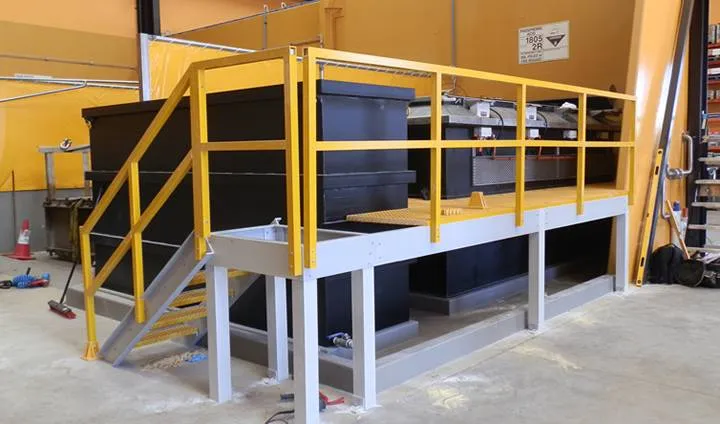
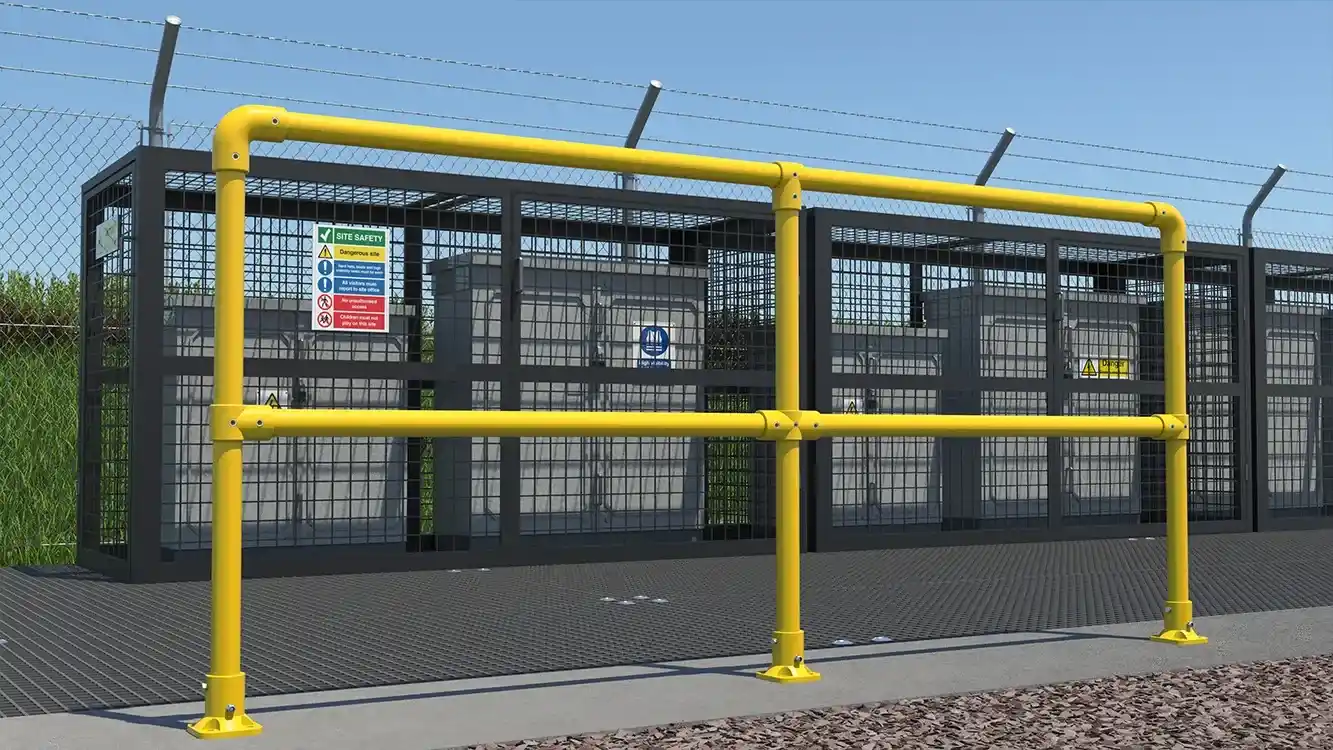
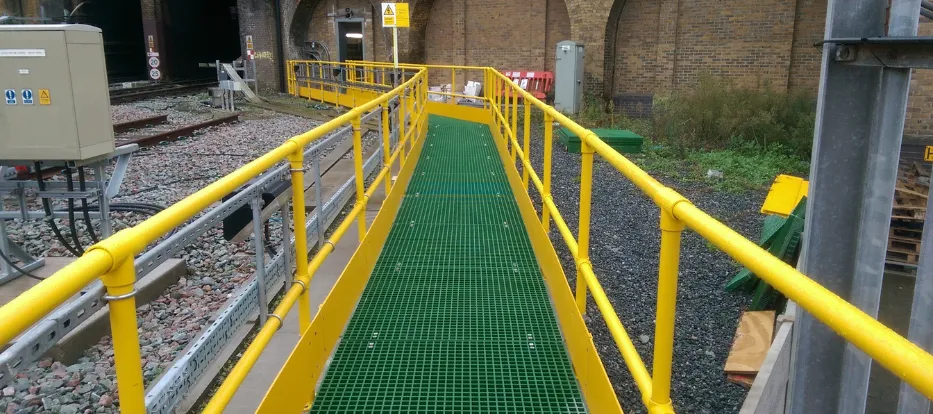
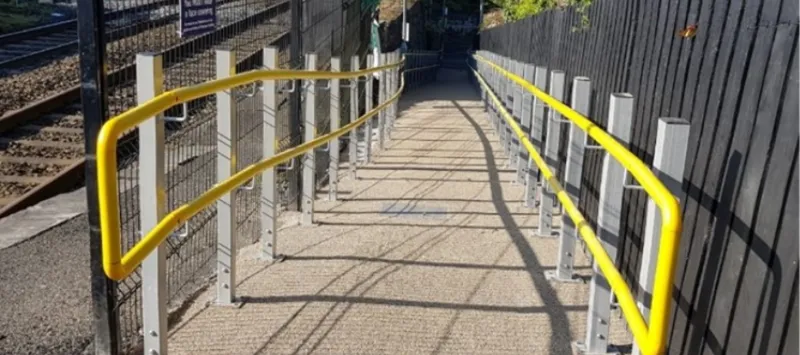
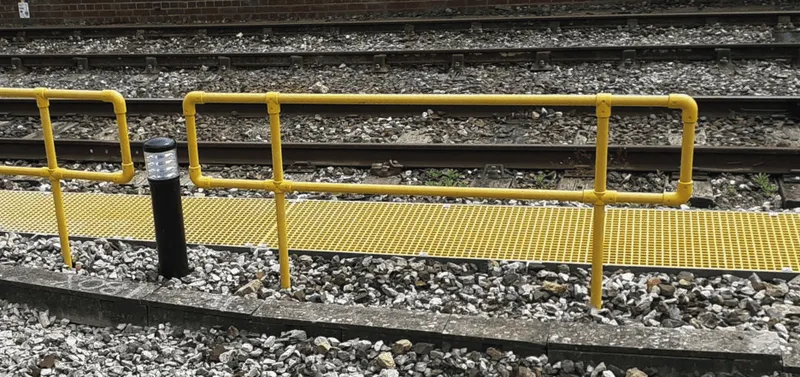
A properly manufactured FRP guardrail system in service — the difference between a qualified factory and an unreliable supplier becomes visible after years of exposure.
Factory-Direct vs Distributor: The Pricing Reality
Most FRP guardrails sold in North America and Europe pass through at least one distributor layer before reaching the end user. Each layer adds 25–50% markup. Sourcing factory-direct eliminates these layers — but only if you're buying from the actual manufacturer, not a trading company posing as one.
| Comparison | Factory-Direct (Dengtai) | US Distributor | Trading Company |
|---|---|---|---|
| Price Markup | Factory cost + margin | Factory cost + 25–50% | Factory cost + 30–60% |
| Custom Engineering | In-house — direct communication | Via manufacturer — slow turnaround | No capability — middleman only |
| Quality Traceability | Batch-level, raw material to shipment | Limited to what manufacturer provides | Unknown — often multiple sources |
| MOQ Flexibility | 100 LF for standard configurations | Usually requires full container | Fixed — no negotiation power |
| Lead Time Control | 15–25 working days to FOB | Adds 1–4 weeks for coordination | Unpredictable — depends on supplier |
| Third-Party Inspection | Welcomed — SGS, BV, TUV | Difficult to arrange | Often refused or delayed |
Bottom line: For projects over 500 linear feet, factory-direct sourcing typically saves $15,000–$40,000 versus distributor pricing. The key is verifying you're dealing with the actual manufacturer — not a trading company with a factory photo on their website.
Dengtai FRP Guardrails Manufacturing: By the Numbers
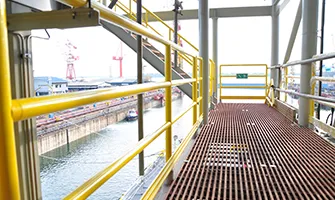
Dengtai FRP guardrail manufacturing facility — ISO 9001:2015 certified since 2008, serving clients across 6 continents.
| Year | Milestone | Significance for Buyers |
|---|---|---|
| 2000 | Founded in Shijiazhuang, Hebei | 25+ years of pultrusion expertise — not a recent market entrant |
| 2005 | Dedicated guardrail production line | Specialized FRP guardrail manufacturing, not a general FRP shop |
| 2008 | ISO 9001:2015 certified | 15+ years of documented quality management — third-party audited |
| 2012 | Global export operations launched | 13+ years of international logistics experience — HS codes, customs, freight |
| 2017–Today | Advanced pultrusion + vinyl ester fire-rated systems | ASTM E-84 Class I capability — meets the strictest fire safety requirements |
Quality Control: What Happens Before Your Guardrails Ship
| QC Stage | What We Check | Standard / Method | Documentation |
|---|---|---|---|
| 1. Raw Material Receiving | Glass fiber roving spec, resin batch certification, UV inhibitor concentration | Supplier COA verification | Material Receiving Report |
| 2. In-Process Pultrusion | Line speed, die temperature, pull force, dimensional tolerance (±0.5mm) | Internal QC Standard QP-002 | Production Run Sheet |
| 3. Post-Cure Inspection | Barcol hardness, visual surface quality, color consistency | ASTM D2583 | Inspection Log per Batch |
| 4. Dimensional Verification | Profile dimensions, straightness, cut length accuracy | Project Spec / CAD Drawing | Dimensional Report |
| 5. Assembly & Load Test | Sample assembly fit, 200 lb (890 N) concentrated load test | OSHA 29 CFR 1910.29(b) | Load Test Certificate |
| 6. Pre-Shipment Inspection | Quantity, labeling, packaging integrity, rust-free hardware | Packing List / PO verification | PSI Report + Photos |
Certifications & Compliance: What Your Engineer Needs to See
When your project spec calls for ASTM E-84 Class I fire rating or OSHA 29 CFR 1910.29 compliance, you need documentation — not verbal assurances. Dengtai provides the following certifications and test data with every order:
| Standard | Requirement | Dengtai Documentation |
|---|---|---|
| ISO 9001:2015 | Quality management system | Certificate No. [available on request] — valid, current, covers FRP pultrusion |
| ASTM E-84 | Surface burning: Class I (flame spread ≤25, smoke ≤450) | Test report from accredited lab — available for vinyl ester guardrail systems |
| ASTM D638 | Tensile properties of FRP | Test data: tensile strength exceeds 30,000 psi (207 MPa) longitudinal |
| OSHA 29 CFR 1910.29 | Guardrail height (42"), load capacity (200 lb), toeboard requirements | Compliance statement + load test certificate per batch |
| IBC | Guardrail 42" minimum, 4-inch sphere rule | Standard 2-rail: compliant. Picket rail (ADA): 4-inch sphere verified |
MOQ, Lead Times & Logistics: What to Expect
- Standard catalog: 100 LF (30m) — LCL shipping available
- Custom configurations: 200–500 LF depending on complexity
- Sample orders: 50 LF for evaluation — air freight available
- Catalog configurations: 15–25 working days to FOB
- Custom engineering: add 2–4 weeks for design review
- Rush orders: available — contact us with timeline
- US West Coast: 18–25 days ocean
- US East Coast: 25–35 days ocean
- Europe: 25–30 days ocean
- Middle East: 15–25 days ocean
- Air freight: 5–7 days worldwide
How to Request a Quote & What to Include
To get an accurate quotation within 24 hours, include these details in your inquiry:
| Information | Example | Why It Matters |
|---|---|---|
| Linear Footage | 2,000 LF total | Determines volume pricing tier and container planning |
| System Type | 2-rail standard / 3-rail / picket / heavy-duty | Affects component count, material usage, and labor |
| Resin Preference | Polyester or Vinyl Ester | 20–30% cost difference; vinyl ester required for fire-rated or aggressive chemical |
| Delivery Port / Address | Port of Houston, TX | Determines ocean freight cost and transit time estimate |
| Project Timeline | On-site installation by March 2027 | Ensures production and shipping schedule aligns with your project |
| Special Requirements | ASTM E-84 Class I fire rating required | Triggers resin selection and documentation package |
What Procurement Officers Say About Factory-Direct Sourcing
"Switching from a US distributor to factory-direct with Dengtai saved us $28,000 on a 1,800 LF chemical plant project. The documentation package — ISO cert, ASTM test reports, load test certificates — was more complete than what our previous distributor provided."
— Project Procurement Manager, Gulf Coast Chemical Facility
"We visited three factories in China before selecting Dengtai. Their production floor was the cleanest, their QC lab had calibrated equipment, and they walked us through their entire traceability system. Three years later, zero quality issues on 5,000+ LF delivered."
— Senior Engineer, European Water Treatment EPC
Frequently Asked Questions About FRP Guardrail Manufacturers
Request: (1) ISO 9001 certificate — verify it covers FRP pultrusion manufacturing, not just trading. (2) Factory address — check on Google Maps for an actual production facility. (3) Recent project photos with client names. (4) Third-party inspection — a legitimate factory welcomes SGS/BV/TUV; a trading company will make excuses. (5) Video call — ask to see the production line live. Dengtai offers all five without hesitation.
A manufacturer owns and operates pultrusion production lines, employs engineers, and maintains QC labs. They control raw material sourcing, production scheduling, and quality from start to finish. A trading company buys from manufacturers and resells — they cannot customize products, provide test data, or guarantee batch traceability. Red flags: no factory address on website, no production photos with identifiable equipment, and inability to arrange factory visits.
Factory-direct pricing typically saves 30–50% versus US distributor pricing for equivalent specifications. For a 2,000 LF project, this often translates to $15,000–$40,000 in savings. The trade-off is managing international logistics, but an experienced export manufacturer handles documentation, customs clearance, and freight coordination — making the process straightforward for the buyer.
ISO 9001:2015 is the baseline — it ensures documented quality processes. Beyond that, look for ASTM testing capability (E-84 fire rating, D638 tensile), OSHA compliance documentation, and the ability to provide load test certificates. A manufacturer serving international markets should also demonstrate export experience with proper HS code classification and customs documentation.
Yes. Dengtai offers sample orders starting at 50 LF for evaluation. Samples are fabricated to your exact specifications and shipped via air freight (5–7 days worldwide). This allows your engineering team to verify dimensional accuracy, finish quality, and fit before committing to full production. Third-party inspection can also be arranged on sample orders.
Production: 15–25 working days for standard catalog configurations. Ocean freight: 18–35 days depending on destination (US West Coast fastest, East Coast longest). Total from order to delivery: approximately 6–9 weeks for most US destinations. Air freight is available for urgent orders (5–7 days) at a premium. Rush production is available on request.
Start Your FRP Guardrail Manufacturer Evaluation
Request a Quote & Factory Documentation Package
Tell us your project requirements. We will return a formal quotation with technical drawings, compliance documentation, QC process details, and shipping options within 24 hours.
Include: Linear footage • System type • Resin preference • Delivery port • Timeline • Special requirements