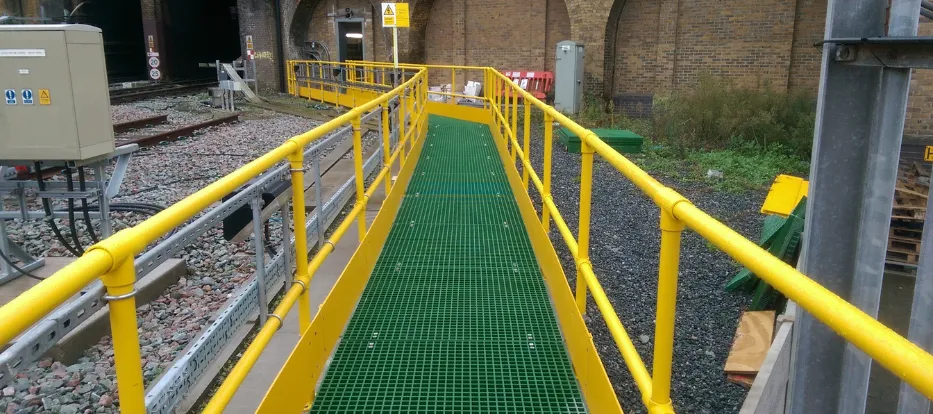
Introduction to Guardrail Height Requirements
When designing or inspecting industrial workplaces, one of the most critical safety considerations is guardrail height requirements. Whether you are a facility manager, safety officer, or contractor, understanding the correct railing dimensions can mean the difference between a compliant workplace and one that puts workers at serious risk. This comprehensive guide covers fall protection standards under OSHA, IBC building codes, and state-specific regulations — giving you everything you need to ensure your safety systems meet legal and safety obligations.
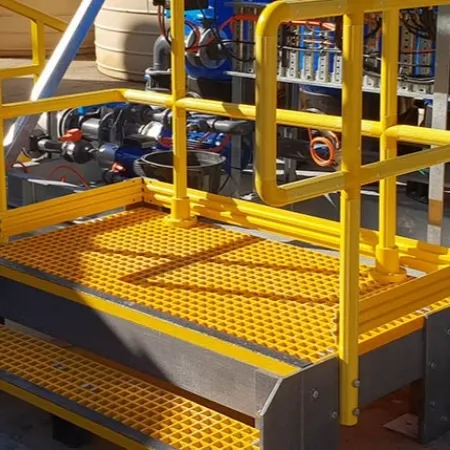
Fall hazards are among the leading causes of workplace injuries and fatalities. Guardrails serve as the primary passive fall protection system in industrial facilities, warehouses, loading docks, mezzanines, and rooftops. The stakes are high: improper railing height not only invites OSHA citations but also fails to protect workers from potentially fatal falls. In this guide, we answer the most common questions about OSHA guardrail standards, including the OSHA required height for guardrails, how to measure guardrail height properly, and whether these standards differ across states and building codes.
What Is the OSHA Required Height for Guardrails?
The OSHA required height for guardrails is explicitly defined in 29 CFR 1910.29(b)(1) for general industry and 29 CFR 1926.502(b)(1) for construction. According to these OSHA guardrail requirements, the top rail of a guardrail system must be 42 inches (107 cm) above the walking-working surface, with a tolerance of plus or minus 3 inches (8 cm). This means the acceptable range is between 39 and 45 inches.
The 42-Inch Standard for Guardrail Height
The 42-inch standard is not arbitrary — it is based on extensive biomechanical research into the average adult center of gravity. When a worker leans or falls against a guardrail, the top rail must be high enough to prevent them from tipping over. The 42-inch height serves as the standard for virtually all general industry applications, including:
- Platforms and mezzanines
- Rooftop edges and skylight openings
- Loading dock edges
- Catwalks and elevated walkways
- Industrial stairways and landings
- Open-sided floors above 4 feet
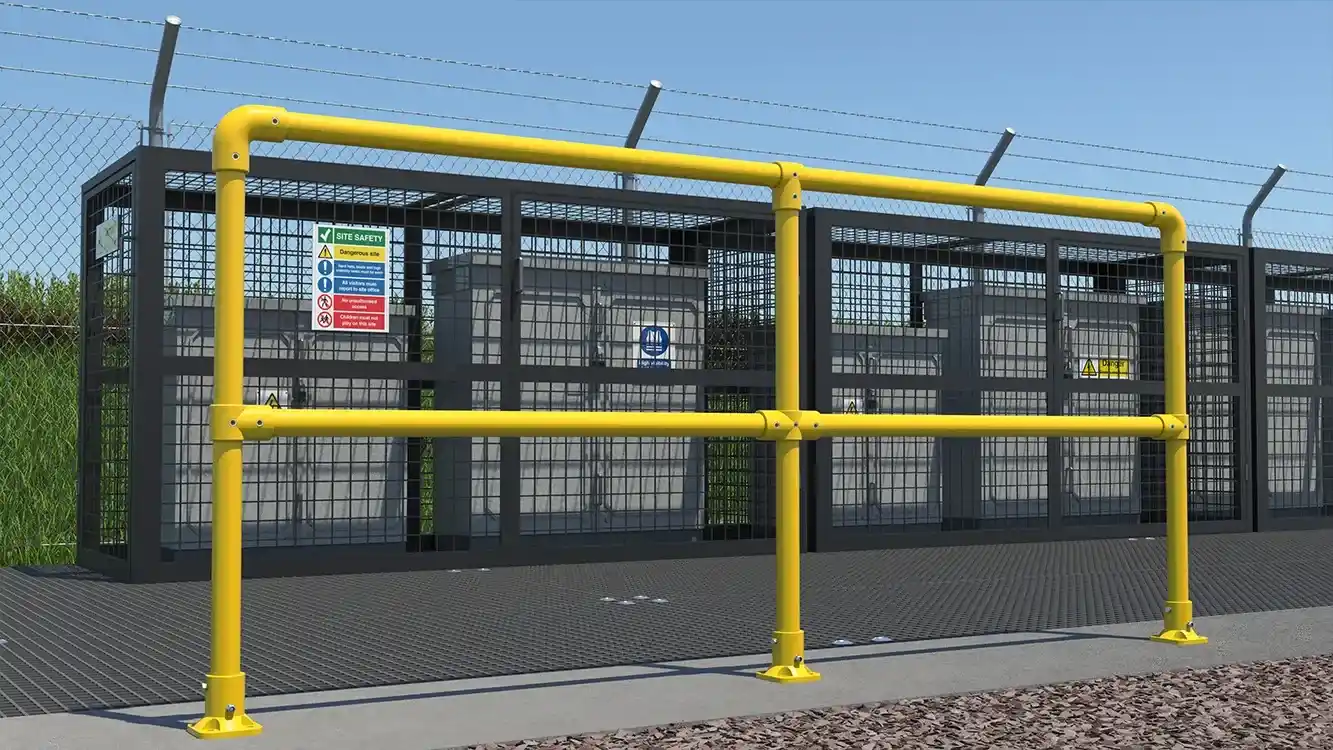
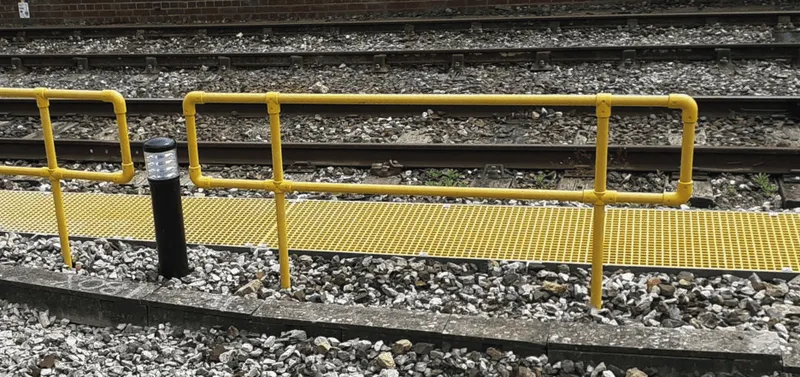
It is important to note that the 42-inch measurement is taken from the walking-working surface to the top edge of the top rail. This measurement standard applies regardless of the type of guardrail material — whether steel, aluminum, or fiberglass reinforced plastic (FRP) guardrails.
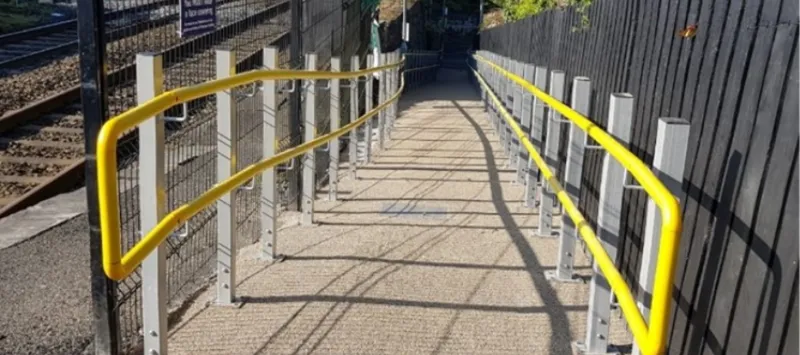
For OSHA handrail requirements for platforms, handrails must be between 30 and 38 inches in height when measured from the stair tread nosing or ramp surface. This differs from guardrail height because handrails are designed for grasping and support, not fall prevention.
OSHA Guardrail Requirements for Industrial Facilities
For industrial facilities, the standard guardrail height requirement follows the OSHA 42-inch rule, but additional specifications apply. Understanding OSHA guardrail requirements for industrial settings goes beyond just height — it encompasses the entire guardrail system design.
Minimum Height for Industrial Safety Guardrails
The minimum height for industrial safety guardrails under OSHA is 42 inches (measured from the walking surface to the top rail). However, the effective height can be reduced to a minimum of 39 inches when accounting for the ±3-inch tolerance. Despite this tolerance, best practice is to aim for exactly 42 inches to ensure full compliance without relying on the tolerance allowance.
In addition to the top rail height, OSHA specifies these critical dimensions:
| Component | Requirement | OSHA Reference |
|---|---|---|
| Top rail height | 42 inches ± 3 inches | 29 CFR 1910.29(b)(1) |
| Midrail height | 21 inches ± 3 inches | 29 CFR 1910.29(b)(2) |
| Toe board height | 3.5 inches minimum | 29 CFR 1910.29(b)(4) |
| Maximum opening | 19 inches (toe to top rail) | 29 CFR 1910.29(b)(3) |
| Load capacity | 200 lbs top rail, 150 lbs midrail | 29 CFR 1910.29(b)(5) |
OSHA standards also require that the guardrail system withstand a force of at least 200 pounds applied in any downward or outward direction at the top rail. This load requirement ensures that the guardrail will stop a falling worker, regardless of the direction of impact. Industrial guardrails must also be free of sharp edges, splinters, or protrusions that could cause injury.
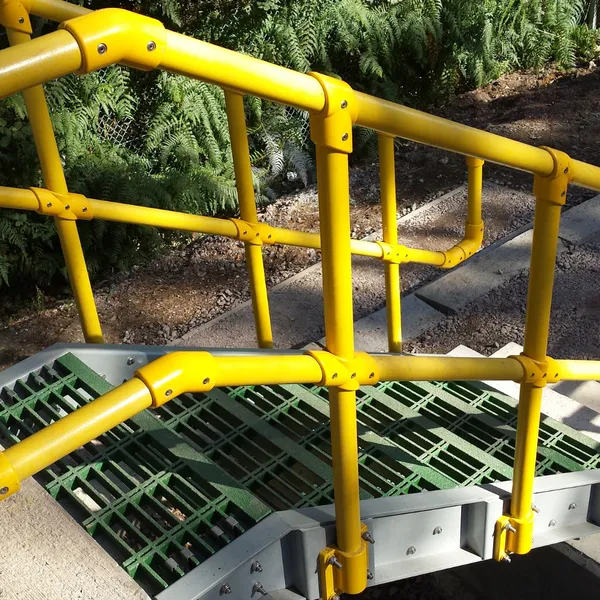
For employers in corrosive environments, materials selection is crucial to maintaining guardrail height osha compliance over the long term. Fiberglass reinforced plastic (FRP) guardrails are increasingly popular in chemical plants, wastewater facilities, and marine environments because they meet all OSHA load and height specifications while resisting corrosion that would compromise steel systems over time.
How Is Guardrail Height Measured Properly?
Knowing the height number is one thing — measuring it correctly is another. How guardrail height is measured properly is a common source of confusion and compliance errors. OSHA and IBC standards agree on the measurement method, but precise technique matters.
Measuring from the Walking Surface
To measure guardrail height requirements correctly, follow these steps:
- Identify the walking-working surface: This is the floor, platform, or surface that the worker stands on. Do not measure from the ground below or from the base plate of the guardrail post.
- Use a vertical measurement: Place a tape measure or laser measuring tool vertically from the walking surface straight up to the top edge of the top rail. The measurement must be perpendicular to the walking surface, not angled.
- Measure at multiple points: Guardrails that are not perfectly level may vary in height along their length. Measure at both ends and the middle, and record the minimum height. The shortest measurement must still meet the 42-inch requirement (or fall within the 39-45 inch tolerance).
- Check midrail height: For guardrail systems with a midrail (required for most applications), measure from the walking surface to the top of the midrail. OSHA requires this to be 21 inches ± 3 inches.
- Verify toe board clearance: The opening between the walking surface and the bottom of the guardrail system must not exceed 19 inches at any point when combined with the midrail and top rail placement.
One common measurement mistake is measuring from the floor below a platform or from an uneven surface. Always use the actual walking surface as your starting point. When measuring outdoor guardrails on rooftops, account for gravel, pavers, or membrane surfaces that may compress under foot traffic. The measurement must be taken from the finished walking surface, not from the roof deck beneath insulation or waterproofing layers.
For existing installations undergoing a safety audit, use a calibrated measuring tool and document all measurements. Many safety inspectors will spot-check multiple locations along a guardrail run, so consistency across the entire installation is important for maintaining OSHA compliant guardrail height.
IBC Guardrail Height Requirements Compared to OSHA
While OSHA sets workplace safety standards, the IBC (International Building Code) governs guardrail requirements for building construction. Understanding where these two codes align and diverge is essential for architects, engineers, and facility managers.
The IBC requirements for guardrail height are specified in IBC Section 1015. According to the 2021 IBC, guardrails are required on open-sided walking surfaces that are more than 30 inches above the floor or grade below. The minimum guardrail height under IBC is 42 inches for most occupancies — the same as OSHA. However, there are important distinctions:
| Aspect | OSHA (29 CFR 1910) | IBC (2021) |
|---|---|---|
| Minimum top rail height | 42 inches ± 3 inches | 42 inches |
| Trigger height for guardrails | 48 inches (4 feet) | 30 inches |
| Midrail requirement | Required | Not specified (infill req.) |
| Load requirement | 200 lbs top rail | 200 lbs (50 plf) |
| Opening limitation | 19 inches max | 4-inch sphere max |
A key difference: IBC requires guardrails at a lower fall height (30 inches) compared to OSHA (48 inches for general industry). This means a mezzanine that is 36 inches high would require guardrails under IBC but not necessarily under OSHA. However, most facilities comply with both codes, and prudent safety practice follows the stricter requirement. When considering guardrail height osha vs IBC compliance, always design to the more stringent code for your specific application.
Another distinction: IBC uses a 4-inch sphere test for infill openings (designed to prevent children from passing through), while OSHA uses a 19-inch maximum opening measurement between the top rail and walking surface. For industrial facilities that must meet both codes, the IBC infill requirement typically governs guardrail baluster spacing.
When designing facilities that fall under both OSHA and IBC jurisdiction — such as a new building with industrial mezzanines — it is safest to design to the stricter of the two standards: 42-inch guardrail height, 4-inch infill spacing, and 200-pound load capacity. This approach ensures compliance with guardrail height osha and IBC standards regardless of which agency inspects.
Do Guardrail Height Requirements Vary by State?
A common question among safety professionals is: Do guardrail height requirements vary by state? The answer is nuanced.
OSHA is a federal agency, and its standards apply across all 50 states. However, states with OSHA-approved State Plans can adopt their own occupational safety and health standards, provided they are at least as effective as federal OSHA. Currently, 22 states and territories operate OSHA-approved State Plans covering private sector and public sector workers, including California, Washington, Oregon, Michigan, and New York.
States most likely to have stricter guardrail standards:
- California (Cal/OSHA): Cal/OSHA Title 8 specifies top rail heights of 42 inches, consistent with federal OSHA, but with additional requirements for specific industries such as construction and agriculture.
- Washington (WISHA): Washington Industrial Safety and Health Act (WISHA) follows the 42-inch standard but may impose additional inspection and certification requirements.
- Michigan (MIOSHA): Michigan OSHA program mirrors federal fall protection standards but can propose stricter rules through its state rulemaking process.
- Oregon (OR-OSHA): Oregon adopts federal OSHA standards by reference but adds specific provisions for forest-related activities and agriculture.
For building code purposes, states adopt the IBC with amendments. Most states adopt the current or recent edition of the IBC, but the specific edition year and any amendments vary. For example:
- Florida: Florida Building Code adopts the IBC with state-specific amendments for wind resistance that may affect railing design.
- New York: New York State Building Code may have different railing height rules for certain residential and commercial applications.
- Texas: Texas adopts the IBC without significant amendments to guardrail provisions.
The best practice is always to check both federal OSHA standards (as the baseline) and your specific state regulations. For facilities operating across multiple states, design to the most stringent applicable standard to ensure uniform compliance. When state and federal rules differ, the more protective standard must be followed.
OSHA Handrail Requirements for Platforms and Midrail Height
In addition to the standards for platform edges, OSHA also specifies handrail requirements for stairways, ramps, and platforms. While guardrails prevent falls from elevated surfaces, handrails provide stability and support for workers moving along stairs or inclined walkways.
Understanding OSHA Handrail Midrail Height Specifications
OSHA defines handrails separately from guardrails in 29 CFR 1910.29(f). The OSHA handrail midrail height and general handrail dimensions follow these specifications:
| Parameter | OSHA Requirement |
|---|---|
| Handrail height (stairways) | 30 to 38 inches from stair nosing |
| Handrail height (ramps) | 30 to 38 inches from ramp surface |
| Handrail clearance from wall | 2.25 inches minimum |
| Handrail gripping surface | Continuous, smooth, no obstructions |
| Handrail diameter | 1.25 to 2 inches (or equivalent shape) |
For OSHA handrail requirements for platforms, handrails are typically required when stairs have four or more risers or when a ramp slope exceeds 1:20. The handrail must provide a continuous gripping surface from the top to the bottom of the stairway, extending at least 12 inches beyond the top and bottom risers.
To maintain an OSHA compliant handrail height, the 30-to-38-inch range must be verified at every stair section. This handrail height is distinct from guardrail height because handrails serve a grasping support function rather than fall prevention. An OSHA compliant handrail height ensures workers of all statures can safely grip and stabilize themselves during stair or ramp use. The OSHA handrail midrail height is specified at 21 inches ± 3 inches when measured from the walking surface. The midrail serves as an intermediate barrier that prevents workers from slipping through the opening between the walking surface and the top rail. For guardrail systems more than 48 inches in height, OSHA may require additional intermediate rails or mesh screening.
Key distinction between guardrails and handrails: Guardrails are fall protection systems designed to prevent people from falling off an elevated edge. Handrails are grasping supports designed to provide balance and stability. A guardrail can serve as a handrail if it meets both sets of requirements, but a handrail alone does not satisfy guardrail requirements unless it meets the 42-inch top rail height and load specifications.
When installing handrail systems in industrial settings, consider the worker population. If your facility employs workers who are shorter or taller than average, you may need to conduct a workplace-specific risk assessment to ensure handrail heights are appropriate for your workforce while still meeting the regulatory range.
OSHA Compliant Guardrail Height: Compliance Checklist
To help you verify that your guardrail systems meet all applicable standards, use this compliance checklist based on OSHA and IBC regulations:
| # | Checklist Item | Status |
|---|---|---|
| 1 | Top rail height measured from walking surface: Is the top rail between 39 and 45 inches (42 inches target)? | ☐ |
| 2 | Midrail installed: Is there a midrail at approximately 21 inches from the walking surface (± 3 inches)? | ☐ |
| 3 | Load capacity verified: Can the top rail withstand 200 pounds of force in any direction? | ☐ |
| 4 | Opening size: Is the maximum opening between the top rail and walking surface 19 inches or less? | ☐ |
| 5 | Toe board installed: Is there a toe board at least 3.5 inches high where falling objects could present a hazard? | ☐ |
| 6 | Trigger height checked: Are guardrails installed on all open-sided surfaces 48 inches (OSHA) or 30 inches (IBC) above the lower level? | ☐ |
| 7 | Handrail height verified: If stair handrails are present, are they between 30 and 38 inches? | ☐ |
| 8 | OSHA compliant guardrail height confirmed: Has the measurement been documented at multiple points along the railing? | ☐ |
| 9 | State regulations reviewed: Has the applicable State Plan been checked for any stricter requirements? | ☐ |
| 10 | Material condition: Is the guardrail system free of corrosion, damage, sharp edges, and loose components? | ☐ |
Regular inspection is the key to maintaining compliance with OSHA guardrail rules. Guardrails that were installed at the correct height can become non-compliant over time due to settling, corrosion, damage, or modifications. Document all inspections with dated photographs and measurement records. For facilities operating under a State Plan, additional documentation may apply.
When designing new guardrail systems, consider specifying the top rail at exactly 42 inches. This central target ensures you remain within the tolerance range even after minor settling or measurement variations. Industrial guardrail systems from reputable manufacturers will clearly indicate their compliance certifications, making verification easier during safety audits.
Why Understanding These Standards Matters for Workplace Safety
Understanding OSHA fall protection standards is not just about regulatory compliance — it directly impacts worker safety and your organization liability. Here is why these standards matter:
Fall prevention is a life-saving measure. According to the Bureau of Labor Statistics, falls to a lower level accounted for over 800 workplace fatalities in recent years. Properly installed guardrails at the correct height are one of the most effective passive fall protection measures available. Unlike personal fall arrest systems that require worker training and active engagement, guardrails provide constant protection without requiring any action from the worker.
Regulatory consequences are significant. OSHA citations for guardrail violations can result in substantial fines. In 2024, OSHA penalties increased to $16,131 per serious violation and up to $161,323 per willful or repeat violation. Beyond the direct financial cost, OSHA citations can trigger increased scrutiny, mandatory safety program overhauls, and reputational damage.
Designing for the long term. Meeting safety standards from the design stage is far more cost-effective than retrofitting non-compliant systems. When guardrails are part of the initial facility design, engineers can ensure proper height, structural support, and anchoring. Retrofits often require costly modifications to floors, posts, and connections.
Material selection impacts compliance longevity. The durability of your guardrail system affects how well it maintains its height over time. Steel guardrails in corrosive environments may rust and weaken, while fiberglass reinforced plastic (FRP) guardrails maintain their structural integrity and height specifications for decades without maintenance. For facilities in chemical, wastewater, marine, or food processing environments, selecting corrosion-resistant materials ensures that your OSHA compliance is not compromised by material degradation.
Worker confidence and productivity. When workers know that guardrails meet safety standards at the proper height, they move more confidently in elevated work areas. This psychological benefit translates into better productivity and reduced hesitation when working near edges or on elevated platforms. Clearly visible, well-maintained guardrails also signal that the employer prioritizes safety, contributing to a positive safety culture.
Conclusion
Navigating OSHA fall protection regulations does not have to be complicated, but getting the details right is essential. The key takeaways from this guide are:
- The OSHA required height for guardrails is 42 inches ± 3 inches from the walking surface to the top of the top rail.
- The minimum height for industrial safety guardrails is 39 inches (using the allowable tolerance), but 42 inches is the recommended target.
- How guardrail height is measured properly directly affects compliance — always measure vertically from the finished walking surface.
- IBC requirements for guardrail height also specify 42 inches but use a different trigger height (30 inches) and infill opening standard (4-inch sphere).
- Guardrail height requirements vary by state in some cases — check your State Plan for stricter standards.
- OSHA handrail requirements for platforms specify 30 to 38 inches for stair handrails, while the OSHA handrail midrail height is 21 inches ± 3 inches.
To ensure your facility is fully protected, perform regular inspections using the compliance checklist provided in this guide, document all measurements, and choose guardrail materials that will maintain their structural integrity over the life of the installation. When in doubt, consult a qualified safety engineer or OSHA compliance specialist to review your specific application.
For more information, the complete OSHA standards are available at osha.gov under 29 CFR 1910 Subpart D (Walking-Working Surfaces) and 29 CFR 1926 Subpart M (Fall Protection). The IBC 2021 edition is published by the International Code Council. Always verify which edition of each code is currently adopted in your jurisdiction, as requirements can change when new editions are published.