What Are FRP Guardrails? Definition & Components
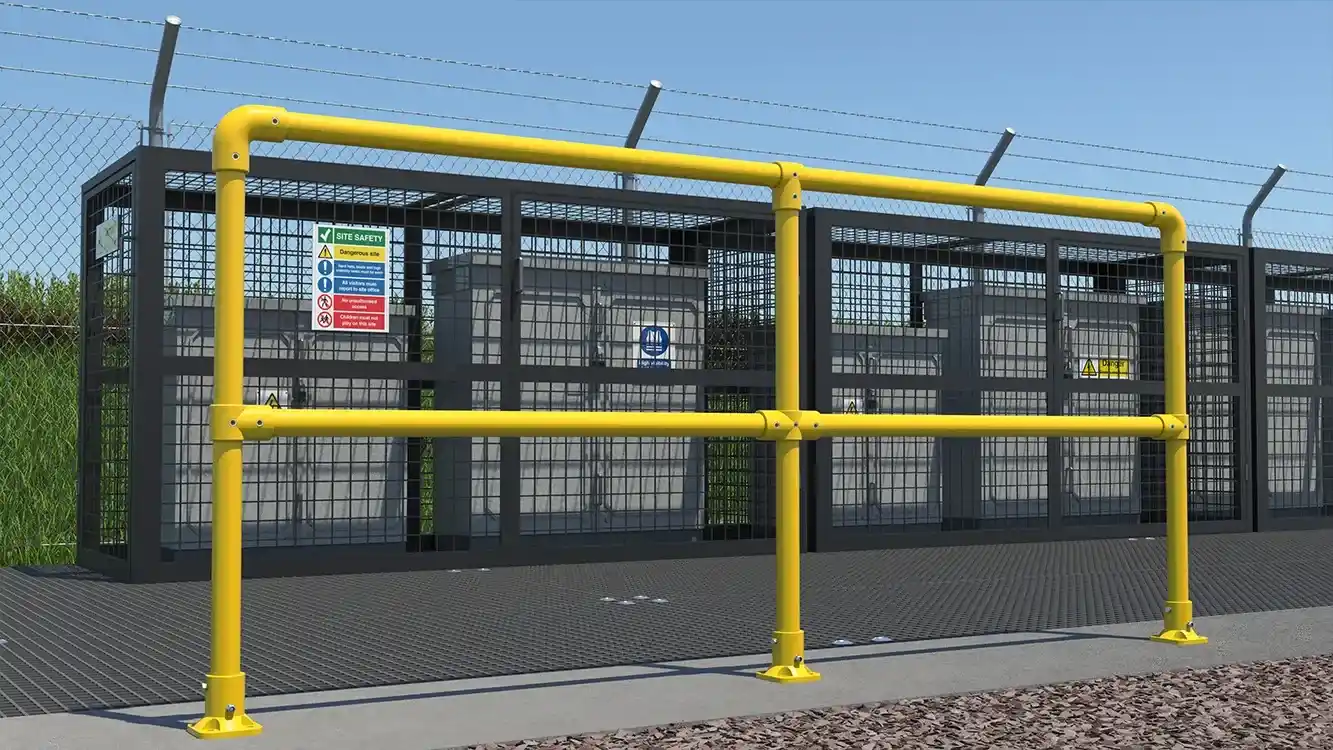
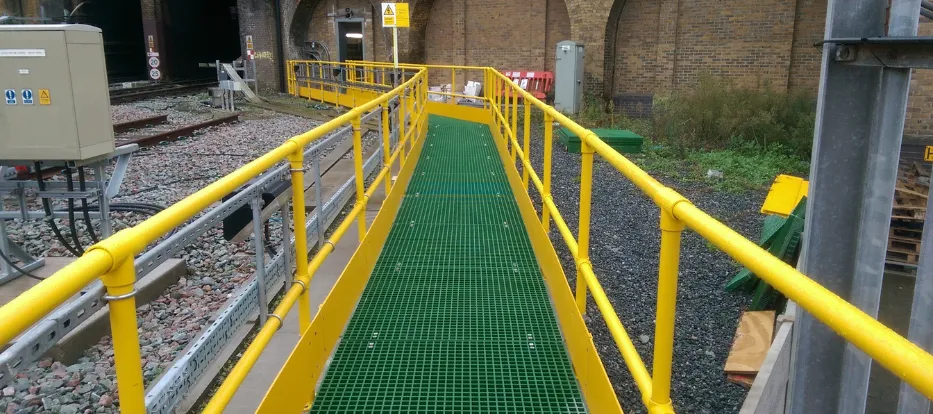
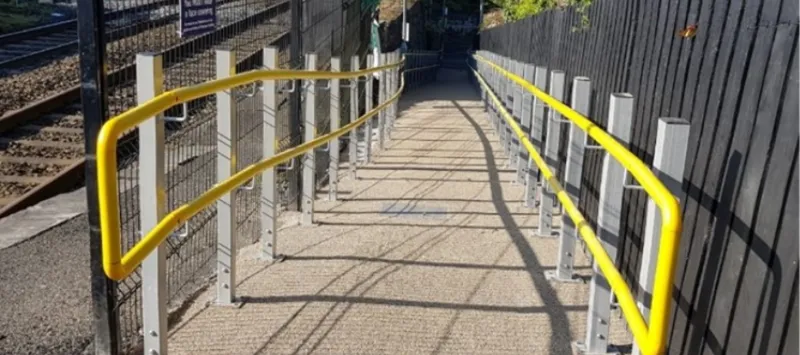
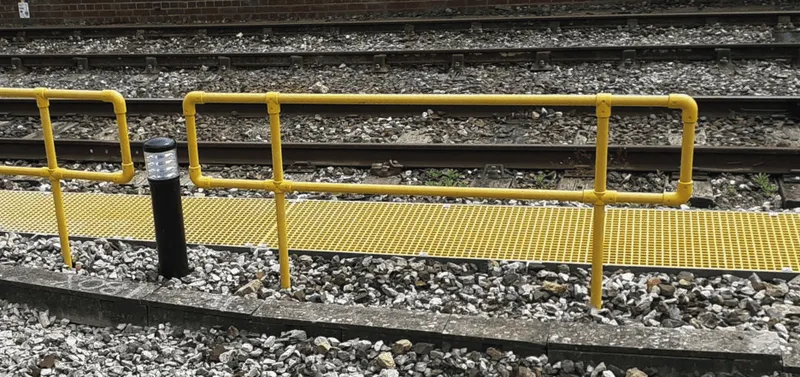
FRP (Fiberglass Reinforced Plastic) guardrails are industrial safety barrier systems fabricated from pultruded fiberglass structural components. Unlike traditional steel or aluminum railing, FRP guardrails combine continuous glass fiber reinforcement with a thermoset polymer resin matrix — typically isophthalic polyester or vinyl ester — creating a material that is simultaneously lightweight, exceptionally strong, and inherently corrosion-resistant.
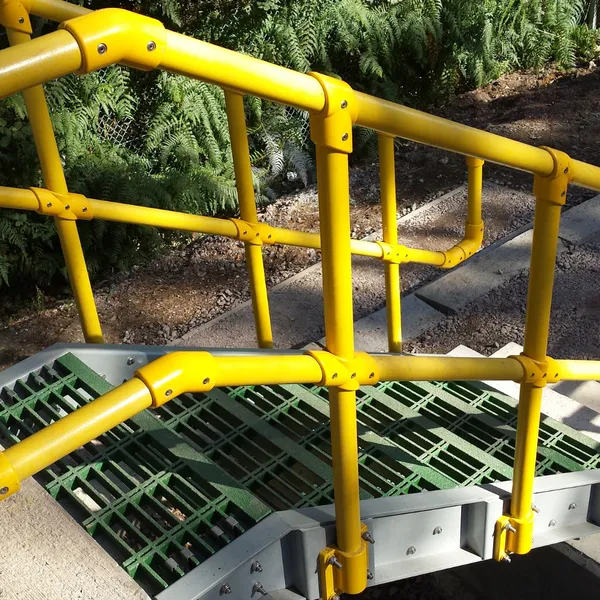
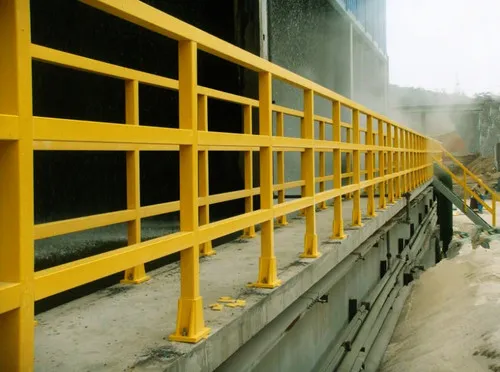
A complete FRP guardrail system consists of five primary components:
- Posts — Vertical support members, typically 2" × 1/4" square pultruded tubes. Available in top-mount or side-mount designs.
- Top Rail — The uppermost horizontal member serving as both hand grip and structural load path. Installed at 42 inches (1067 mm) per OSHA standard.
- Mid Rail — Intermediate barrier positioned approximately halfway between top rail and walking surface. Available in round tube (standard) or square tube (heavy-duty).
- Kickplate — A 4-inch (100 mm) vertical barrier at the base to prevent tools and debris from falling off elevated platforms per OSHA 1910.29(k).
- Fittings & Fasteners — FRP or SS316 connectors including base flanges, elbows, tees, and swivels. All hardware is corrosion-resistant.
FRP guardrails are manufactured through pultrusion — a continuous process where glass fiber rovings are pulled through a resin bath and heated precision die, producing structural shapes with consistent cross-sections and tensile strength exceeding 30,000 psi (207 MPa) per ASTM D638. They arrive pre-cut to specified lengths and bolt together with standard tools — no welding, no hot work permits required.
FRP Guardrail Material Properties & Performance Advantages
Understanding the material science behind FRP guardrails explains why they outperform traditional metal railing. Below are the key performance advantages organized by what matters most to engineers and facility managers.
- Corrosion Resistance — The Defining Advantage. FRP guardrails are inherently immune to rust, galvanic corrosion, and chemical attack. Unlike galvanized steel (zinc coating that eventually sacrifices itself) or aluminum (pits in alkaline environments), FRP's polymer matrix provides through-thickness protection. This makes FRP the definitive choice for chemical plants, water treatment, marine environments, and any location exposed to acids, alkalis, or salts. Explore our corrosion-resistant FRP handrail solutions for the most aggressive chemical processing environments.
- High Strength-to-Weight Ratio. At roughly 1.8 g/cm³, FRP is 75% lighter than steel yet delivers tensile strength comparable to structural steel in the fiber direction. A single worker can carry a 20-foot section that would require two workers in steel — reducing installation labor, shipping costs, and structural load on platforms.
- Electrical Non-Conductivity. FRP guardrails do not conduct electricity — essential for substations, power generation, and telecom installations. Unlike steel (requiring complex grounding), FRP provides inherent electrical safety.
- Fire Retardant Performance. Vinyl ester FRP guardrails achieve ASTM E-84 Class I rating (flame spread ≤25, smoke developed ≤450) — the highest classification for interior finish materials, often required for occupied industrial facilities and offshore platforms.
- UV & Weather Resistance. Integrated UV inhibitors prevent surface degradation and color fading. Unlike painted steel (periodic repainting) or wood (rots), FRP maintains structural integrity for 25+ years with zero surface treatment.
FRP vs Steel vs Aluminum: Complete Guardrail Material Comparison
For a deeper analysis, see our FRP vs steel comparison for industrial applications. The table below expands the analysis to all three materials with quantitative data.
| Property | FRP (Fiberglass) | Steel (Galvanized) | Aluminum |
|---|---|---|---|
| Density | 1.8 g/cm³ (112 lb/ft³) | 7.85 g/cm³ (490 lb/ft³) | 2.7 g/cm³ (169 lb/ft³) |
| Tensile Strength | 30,000–40,000 psi (207–276 MPa) | 58,000–80,000 psi (400–550 MPa) | 40,000–45,000 psi (276–310 MPa) |
| Strength-to-Weight | Excellent (highest) | Good | Very Good |
| Corrosion Resistance | Excellent — immune to rust, acids, alkalis, salts | Poor — zinc coating degrades; rusts when breached | Moderate — pits in alkaline/chloride environments |
| Electrical Conductivity | Non-conductive (dielectric) | Highly conductive | Highly conductive |
| Fire Rating | ASTM E-84 Class I (vinyl ester) | Non-combustible (loses strength at 500°F+) | Non-combustible (melts at 1,220°F) |
| Maintenance (20yr) | Zero — no painting or coating | High — sandblasting, painting, rust repair | Moderate — anodizing may wear |
| Lifecycle Cost | Low — 25+ year service life | High — ongoing maintenance + replacement | Moderate — shorter life in corrosive settings |
| Best Applications | Chemical plants, water treatment, marine, electrical, outdoor industrial | Indoor dry, temporary, low-corrosion | Architectural, light commercial, non-corrosive outdoor |
The reality is: For any industrial environment where corrosion, electrical safety, or maintenance cost matters, FRP guardrails deliver lower total cost of ownership than both steel and aluminum — often by a factor of 2–3× over 20 years.
FRP Guardrail System Types & Component Specifications
FRP guardrails are available in multiple configurations. Below are the standard system types and detailed component specs. For the full product range, see our FRP guardrail product catalog.
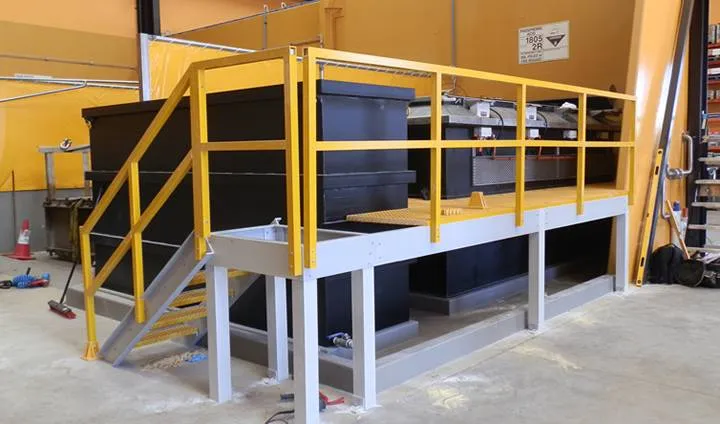
Top rail + mid rail + kickplate. Most common industrial configuration. Meets OSHA 29 CFR 1910.29.
Additional intermediate rail for enhanced protection and longer post spans.
Vertical infill between rails. ADA-compliant — prevents passage of 4-inch sphere.
All components 2" × 1/4" square tube. For high-traffic areas and heavy impact risk.
Component Specifications
| Component | Material | Standard Dimensions | Options |
|---|---|---|---|
| Post | Pultruded FRP square tube | 2" × 3/16" (Std) / 2" × 1/4" (HD) | Top-mount or side-mount |
| Top Rail | Pultruded FRP square / oval | 2" × 3/16" sq or 2-1/8" × 1-1/2" oval | Square or ergonomic oval |
| Mid Rail | Pultruded FRP round / square | 1-1/2" Ø × 1/8" rd / 2" × 1/4" sq | Round (Std) or square (HD) |
| Kickplate | Pultruded FRP ribbed | 4" × 1/2" × 1/8" | Standard 4" (100mm) |
| Base Plate | FRP molded / SS316 | Matched to post profile | FRP (std) or SS316 |
| Fasteners | Stainless Steel 316 | Per engineering spec | Through-bolt or rivnut |
Industrial Applications: Where FRP Guardrails Excel
Acids (HCl, H²SO&sup4;), alkalis, solvents. FRP polymer matrix provides through-thickness chemical immunity.
Chlorine, H²S, constant moisture. Steel fails in 5–8 years; FRP lasts 25+.
Salt spray, humidity, UV. FRP is inherently immune — zero galvanic corrosion.
Substations, transformers. Non-conductive FRP eliminates grounding and step-potential risks.
Offshore platforms. Vinyl ester FRP with Class I fire rating for topside and subsea structures.
Washdown environments. FRP resists repeated sanitation cycles; no corrosion pits for bacteria.
FRP guardrail after years of service in a chemical processing environment — the polymer matrix provides through-thickness corrosion immunity.
How Much Do FRP Guardrails Cost? Factory Pricing Guide
FRP guardrail pricing depends on five factors: resin system (polyester vs vinyl ester), configuration (2-rail vs 3-rail vs picket), duty rating, order volume, and customization. Below are factory-direct estimates for budget planning.
- Resin System: Vinyl ester adds ~20–30% vs polyester. Required for aggressive chemical exposure and fire-rated applications.
- Configuration: 2-rail standard is most economical. 3-rail adds ~15–20%. Picket-style (ADA) adds ~25–35%.
- Duty Rating: Heavy-duty (thicker walls) adds ~10–15%.
- Volume Tiers: 100 LF (sample) / 500 LF (small project) / 2,000+ LF (standard) / 10,000+ LF (large-scale).
| Configuration | Resin | Est. Cost per LF* | MOQ | Tier |
|---|---|---|---|---|
| 2-Rail Standard | Polyester | $35–$55 | 100 LF | Economy |
| 2-Rail Standard | Vinyl Ester | $45–$70 | 100 LF | Standard |
| 3-Rail System | Polyester | $50–$75 | 100 LF | Standard |
| 3-Rail System | Vinyl Ester | $65–$95 | 100 LF | Premium |
| Picket Rail (ADA) | Polyester | $70–$100 | 100 LF | Premium |
| Heavy-Duty 3-Rail | Vinyl Ester | $85–$120 | 100 LF | Heavy-Duty |
*FOB China. Includes all components. Excludes shipping, duties, and installation. Ranges for planning — contact us for formal quotation.
Long-term value: While FRP guardrails cost 10–30% more upfront than galvanized steel, break-even occurs within 3–5 years through zero maintenance, lighter shipping (75% less weight), and faster installation. Over 20 years, net savings typically reach 50–70% versus steel.
FRP Guardrail Installation: Step-by-Step Guide
FRP guardrails assemble with standard hand tools — no welding, no hot work permits, no heavy lifting. A two-person crew installs 100–200 linear feet per day.
-
Step 1: Site Layout
Mark post locations per engineering layout. Standard spacing: 8 ft (2.44 m) max on center. Verify substrate is clean, level, and load-capable.
-
Step 2: Install Base Plates
Drill anchor holes per base plate pattern. Concrete: wedge or epoxy anchors. Steel beam: through-bolts with spacers. Grating: FRP pedestal bases.
-
Step 3: Mount Posts
Insert posts, check plumb with level. Temporarily secure. Do not fully tighten until entire run is assembled — allows alignment adjustment.
-
Step 4: Assemble Rails
Position top rail and mid rail. Standard lengths: 10 ft (3 m) or 20 ft (6 m). Join sections at fittings. Cut final segment with carbide-tipped saw. Wear dust protection.
-
Step 5: Secure Fittings
Rivnut system: drill through fitting + tube, insert rivnut, tighten with Pozidriv #3. Through-bolt system: drill, bolt, lock nut. Consistent torque — avoid overtightening.
-
Step 6: Kickplate & Inspection
Secure 4" (100mm) kickplate. Verify: all bolts tight, post spacing ≤8 ft, top rail 42 ±3" (1067 ±76mm) per OSHA 1910.29(b). Confirm 200 lb (890 N) load capacity.
OSHA Compliance & Industry Standards for FRP Guardrails
Dengtai FRP guardrails are engineered and tested for the same standards governing steel and aluminum railing. For dimensional details, see our guide on OSHA guardrail height requirements.
| Standard | Key Requirement | FRP Compliance |
|---|---|---|
| OSHA 29 CFR 1910.29(b) | Top rail 42" ±3". Withstand 200 lb (890 N) concentrated load. | Standard 42" (1067mm). Load-rated at 200 lb per post. |
| OSHA 29 CFR 1910.29(k) | Toeboard min 3.5" tall. Max 1/4" floor gap. | 4" (100mm) ribbed kickplate standard. |
| ASTM E-84 | Surface burning: Class I flame spread ≤25, smoke ≤450. | Vinyl ester FRP achieves Class I rating. |
| ASTM D638 | Tensile properties of plastics. | Exceeds 30,000 psi (207 MPa) longitudinal. |
| IBC | Guardrail 42" min. 4-inch sphere rule. | Standard 2-rail compliant. Picket meets sphere rule. |
| ISO 9001:2015 | Quality management — consistent processes, traceability. | Dengtai certified since 2008. Full material traceability. |
Why Source FRP Guardrails Direct from China Factory
For industrial projects exceeding 500 linear feet, direct factory sourcing delivers 30–50% cost savings versus US distributor pricing — without compromising quality, certification, or lead time.
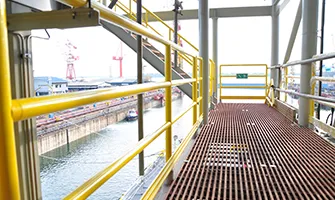
Dengtai FRP guardrail manufacturing facility — ISO 9001:2015 certified since 2008, serving 30+ countries.
Factory Timeline
| Year | Milestone | Description |
|---|---|---|
| 2000 | Founded | FRP pultrusion manufacturing established in Shijiazhuang, Hebei |
| 2005 | Expansion | Added dedicated guardrail/handrail production lines, tripled output capacity |
| 2008 | ISO 9001 Certified | Full quality management system implemented and certified |
| 2012 | Global Reach | Export operations expanded to 30+ countries across 6 continents |
| 2017–Today | Innovation | Advanced pultrusion technology, vinyl ester fire-rated guardrail systems |
- Factory-Direct Pricing — No Distributor Markup. Direct sourcing eliminates distributor margin, warehousing costs, and sales overhead. For a 2,000 LF project, this represents $15,000–$40,000 in savings.
- ISO 9001:2015 Certified Since 2008. Every component is traceable to raw material batch, production date, and QC record. In-process dimensional checks, post-cure inspection, and load testing on sample assemblies.
- Global Export — 30+ Countries. From Texas chemical plants to Dubai water treatment facilities. We manage export documentation, HS code classification, and customs clearance. Regions: North America (USA, Canada, Mexico), Europe (UK, Germany, France, Netherlands, Spain, Italy), Middle East & Africa (UAE, Saudi Arabia, Qatar, Kuwait, South Africa, Nigeria).
- Flexible MOQ. From 100 LF (LCL sample) to 10,000+ LF (multi-container). Third-party inspection (SGS, Bureau Veritas, TÜV) welcomed.
What our clients say:
"Dengtai FRP Guardrail delivered exceptional quality and met our strict corrosion resistance requirements. Their technical support was outstanding."
— Robert K., Chemical Processing Corp
"We have sourced FRP railing from multiple suppliers, and Dengtai consistently offers the best balance of quality, pricing, and delivery reliability."
— Ahmed M., Gulf Engineering Group
Visit our factory-direct FRP guardrail manufacturer page for detailed credentials.
Frequently Asked Questions About FRP Guardrails
Guardrails are safety barrier systems preventing personnel from falling off elevated platforms — they include a top rail, mid rail, and kickplate. Handrails are graspable rails along stairs providing hand support. FRP guardrail top rails often serve dual function as both guardrail and handrail when installed at 42 inches with an ergonomic oval profile.
25+ years in outdoor industrial environments with UV-inhibited resin — significantly outlasting galvanized steel (10–15 years) and aluminum (15–20 years in non-corrosive conditions). FRP never rusts, pits, or requires repainting. Safety yellow color is integrated throughout the resin and cannot flake or peel.
Standard MOQ is 100 linear feet (~30 meters) for catalog configurations. Custom configurations (non-standard heights, colors, fittings): 200–500 LF. LCL shipping available for smaller orders; full-container shipping for 2,000+ LF provides better freight economics.
Yes. Dengtai FRP guardrails meet or exceed OSHA 29 CFR 1910.29: top rail 42" ±3", mid rail ~21", 200 lb (890 N) concentrated load capacity, and 4" kickplate. Custom configurations available for state or local code variations beyond OSHA minimums.
Steel has higher absolute tensile strength (58,000–80,000 psi vs FRP's 30,000–40,000 psi). However, for guardrail applications governed by OSHA's 200 lb load requirement, both materials easily exceed the standard. FRP's advantage is not raw strength but strength-to-weight ratio (75% lighter), corrosion immunity, and zero-maintenance lifecycle.
FRP guardrails do not require painting — color is integrated into the resin during pultrusion and cannot flake or wear off. Standard: safety yellow and grey. Custom colors available with engineering review and minimum order quantities.
Catalog configurations: 15–25 working days to FOB shipment. Custom configurations add 2–4 weeks. Ocean freight: ~18–25 days to US West Coast, 25–35 days to US East Coast, 25–30 days to Europe. Air freight: 5–7 days door-to-door (premium).
Standard hand tools only: 9mm HSS drill bit (supplied), Pozidriv #3 driver, socket wrench set, tape measure, level, carbide-tipped saw blade. No welding, no hot work permits, no specialized trade skills required.
Request Your FRP Guardrail Quote from Dengtai
Get Factory-Direct Pricing for Your Project
Tell us your linear footage, system type, resin preference, and delivery location — our engineering team returns a formal quotation within 24 hours.
Include in your inquiry: Linear footage • System type (2-rail/3-rail/picket) • Resin preference • Delivery port • Timeline